

Growing Up in a Washington, D.C. Neighborhood
Woodley Mansion – 1801
Maryland native Phillip Barton Key built the Federal style Woodley Mansion around 1801. The hilltop manor housed a number of distinguished residents over the years including three U.S. Presidents. The northwest Washington D.C. neighborhood Woodley Park derived its name from the carriage road that led to the house, which still stands at 3000 Cathedral Avenue on the campus of Maret School, a private K-12 institution located on the site since 1952.
The Woodley Lane – 1860s-’90s
“From the head of Connecticut avenue proceeds the Columbia Road, which curves to the eastward and… forks into Woodley Lane (or road) so well known to every equestrian and carriage rider in the District.”
Washington Sunday Herald, Nov. 28, 1886
Rock Creek runs roughly north to south through Washington, D.C., its steep valley a natural barrier to 19th century expansion to the northwest. A lovely carriage lane called the Woodley Road had nevertheless long existed for those with the leisure and horsepower to traverse it. By 1874 investors were advertising “A Superb Suburb on the Famous Woodley Road. Thirty handsome lots in Kervand’s Subdivision of Woodley Park, one half mile from terminus of Connecticut avenue cars and near Kalorama with fine views of the river and city.” 1 Interest was tepid. After a few years of discussions and site surveys, in 1889 a government commission confirmed that Woodley Park was the chosen location for a national zoological park, around the same time that electric streetcars were replacing horse-drawn cars. A group of transportation and real estate investors constructed a 755-foot steel trestle bridge 130 feet over the valley in 1891, their electric streetcar line immediately expanding access to and beyond Woodley Park, where new home construction began in earnest in the early 1900s.

Serendipitous Woodley Park Arrivals – 1953-54
Our Georgia-born maternal grandfather Leon Grayson arrived in Washington in 1935. He briefly stayed in two downtown hotels and a Thomas Circle boarding house before renting a room at ca. 1924 2811 Connecticut Avenue in Woodley Park. Leon wrote his wife Mary that the accommodations cost “about forty-five a month including breakfast and dinner. It’s a little far out – but it will be private with an adjoining room.”
After 20 years in the U.S. Army, our paternal grandparents Santiago and Carmen Guevara with 14-year-old son Nicky retired to Washington in 1953, briefly renting elsewhere before purchasing 2627 Garfield Street, a ca. 1908 rowhouse in Woodley Park. Mary and Leon Grayson, after living across the Rock Creek valley in Brightwood, returned to Woodley Park in 1954 with 12-year-old daughter Ann. Their 4th floor apartment was to be their residence for nearly fifty years.
2632 Garfield Street – 1908
An August 1960 real estate ad reads, “APARTMENTS, 2632 Garfield st. n.w., open today, (3d-fl. apt. with bath, 2d-fl. apt. with bath): 1st floor and basement with bath. Price $23,500.”2 Santiago and Carmen purchased 2632 as a rental investment before Ann and Nicky married in 1961. In 1962 or ’63 our young family moved into the 1st floor/basement apartment of 2632 Garfield. By 1965 the entire house was ours, we eight children growing to adulthood inside and outside its sturdy walls. It too would be in the family for fifty years. Harry Wardman (1869-1938), a prolific Washington, D.C. real estate developer, built more than 5,000 structures in the capital city, those surviving still respected for their solid construction and architectural design.3 Harry Wardman’s legacy cast a literal shadow on our childhood. His first foray into Woodley Park came in 1908 when he built fifteen row houses on Garfield Street, including ours.3

2900 Connecticut Avenue – 1922
Leon and Mary Grayson, “Poppa” and “Mimi” to us, resided a short walk away. South Cathedral Mansions at 2900 Connecticut Avenue is the attractive southern anchor of Harry Wardman’s 1922 mixed-use Cathedral Mansions complex that extends for three city blocks across from the National Zoo.

The Sheraton-Park Hotel – 1918
Harry Wardman’s grandest achievement was the 1918 Wardman Park Hotel (2660 Woodley Road). The eight-story, 1200 room multi-winged structure was a great success, for many years the largest hotel and convention center in Washington despite its remote residential location. In 1928 Wardman tore down his own stately 1909 Spanish-style hilltop home at the corner of Woodley Road and Connecticut Avenue to construct the eight-story Wardman Tower annex (2600 Woodley Road). A lobby-level enclosed lounge and hallway connected the two hotel structures. Renamed the Sheraton-Park in 1953, the hotel was Ann’s employer for 40 years, and a familiar stomping ground for us and our neighborhood friends.

St. Thomas Apostle Parish and School – 1909, ’26, ’51, ’64
St. Thomas Apostle parish, no connection to Harry Wardman, was founded in 1909 and grew with the neighborhood. A parish school opened in three interconnected townhouses on 27th Street in 1926, with the brick and limestone upper church (2665 Woodley Road) finally completed in 1951. In 1964 a new school building (2700 27th Street) replaced the townhomes Ann attended in the 1950s. There we learned our ABCs and the love of Jesus.

Woodley Park Borders
The National Zoo and the Rock Creek valley comprise Woodley Park’s eastern border with Calvert Street to the south, Klingle Road and valley to the north, and Cleveland Avenue/32nd Street to the west. Others name 29th Street its western limit, leaving Woodley Mansion on the outs with its namesake. Regardless, as children we weren’t limited by borders, freely walking for blocks and riding bikes for miles. Rolls of ten-cent student bus tokens offered easy access to the rest of the city.

Woodley Park Memories
An early vision for Woodley Park banned alleys,4 but fortunately for us behind our and nearly every other friend’s home an alley provided a relatively safe play area, “Car, Car, C-A-R” interrupted jump rope and games like kickball, SPUD, and the witch game – a sort of hide/seek/scare game using neighbors’ carports and garages. A scar remains barely visible from an alley jousting tournament on bicycles, broomsticks serving as lances. We’d bounce balls off the brick wall of St. Thomas church, a misfire ending up in a concrete drainage ditch or down the long basement stairwell.


The twins that lived next door built an enormous half-pipe skate ramp. We all rode skateboards, but they were especially skilled. A house at the top of the alley (2800 block of 27th Street) had a wide lawn level with a thigh-high retainer wall – a recessed walkway bisecting the lawn to an entry door. We’d jump back and forth over this walkway trying to dodge crouched “snakes” in the pit.
St. Thomas schoolyard was concrete and bare, enclosed by a 6-foot brick wall with symbolic cross-shaped gaps allowing for ventilation, observation, and footholds to clamber over the wall to retrieve escaped balls. Half the yard was exposed to the elements, the other half in shade under the building. We hit thousands of tennis balls off a wall in the shaded portion and shot basketballs behind two steel backboards that never had hoops, their twin horizontal mounting posts serving as goals.

Each of us went to preschool and kindergarten at Oyster School (2701 29th Street), holding hands with our mother Ann as we kicked the accumulated autumn leaves down 29th Street. Oyster had a small play area with rudimentary equipment, its athletic field backing to the ca. 1964 Sheraton-Park Hotel Motor Inn annex (2701 Calvert Street) driveway. Wooded Cortland Park (2900 block of Cortland Place) had nicer play equipment, more distant Macomb Playground (3409 Macomb Street) yet more. Teresa, Sue, and Cathy were on the swings at Cortland playground “when reps from the movie “Annie” along with the actress who portrayed Daddy Warbucks’ secretary approached and asked us to participate in a sandcastle contest. We were the only ones there. They coaxed us into the sandbox, took a bunch of pictures, we built terrible sandcastles, and they gave us some kind of award and I think an album of the movie soundtrack – we did love that soundtrack! Maybe the movie was premiering at the Uptown Theater?”
The ca. 1936 Art Deco Uptown Theater (3426 Connecticut Avenue) lay across our beloved Klingle Valley Bridge beyond the library. Sue, Rob, and other neighbor boys worked at the Uptown, occasionally letting us in a side door. I was able to see “Star Wars” there seven times. Similarly Art Deco-inspired commercial establishments lined Connecticut Avenue adjacent and across from the theater. Safeway, our closest full service grocery, was managed by Mr. Valentini, the father of a St. Thomas classmate. Tropea’s Barber had stacks of comic books for our reading pleasure as we waited for our turn with Frank or Dino. Eddie Leonard’s sub shop was a teen favorite. Teresa and Sue worked at Crown Books, Rob at Club Soda, and most of us had savings accounts at Perpetual Federal. Julie, Rob, and I delivered newspapers – the Washington Post briefly in our own neighborhood and for two years in Cathedral Park off Woodley Road; the Washington Star on Devonshire Place and at 3000 and 3100 Connecticut Avenue including its small commercial strip. Cathedral Pharmacy proprietor Paul Beringer was also the dad of St. Thomas classmates. He employed Julie, Beth, and me at different times. High’s was convenient for milk, eggs, and Slush Puppies. Oxford Tavern/Zoo Bar was grandfather Poppa’s occasional hangout. The wide sidewalk in front of this strip was always crowded with balloon and food vendors in the summer months. The 2600 block of Connecticut Avenue featured People’s Drug Store, Baskin-Robbins, and Tippy’s Taco House (later Tuscon Cantina), a teen favorite for burritos and queso. Garvin’s Pub hosted a comedy club for a time. For about 15 years nearly all these establishments housed a number of arcade games. Ms. Pac Man, Frogger, and Tron were personal favorites. The Sheraton-Park had a fast food-style restaurant with inside and driveway entries. McShako’s was a play on the names of popular local restaurants McDonalds, Shakey’s and Geno’s. We spent hours on the pinball machines there.
The Sheraton-Park was a good neighbor. For more than 60 years the hotel opened their garage for complimentary St. Thomas church event parking. Most Sunday afternoons would find the neighborhood boys playing tackle football on the sloping front lawn beside its central fountain. Daffodils, azaleas, and other seasonal blooms on the hillside above witnessed Easter egg rolls and picnics. Sheraton offered reasonably-priced memberships to neighbors to use its outdoor swimming pool and ice skating rink. Our family took advantage of the offer for a number of years. St. Thomas classmates lived in the Sheraton and later in the Shoreham Hotel at 2500 Calvert Street. Their dad was resident manager at both for a time, giving us enviable access. The vista from the roof of the Wardman Tower on a snowy day was magnificent. The hotel hosted Teresa’s bridal suite and Ann’s funeral reception. A broadcast tower stood behind the hotel for many years, remnant of the television shows that once originated there.

Maret school was also good neighbor to area children, opening their athletic fields for both organized and impromptu ball games. Twelve-year-old Rob earned the nickname “the doughnut man” at a Little League contest there. Before a key at-bat Rob’s coach promised a case of doughnuts if he hit a home run. The ball landed beyond the outfield on a hill below the Woodley Mansion in right-center, a good sledding hill. The Sheraton lawn was a gentler choice, the challenging hills at the equally-welcoming Swiss Embassy next door to Maret steeper and more thrilling. Joe lamented,“My buddy K– broke his leg sledding at the Swiss embassy then his parents sued, ruining it for everyone.” Most challenging of all was Shoreham Hill. The climb back uphill was brutal. Rob and I made that climb once after burying our childhood dog Lady near Rock Creek at the base of a Taft Bridge pier. She had been hit by a taxi on Woodley Road. Rock Creek would occasionally freeze thickly and smoothly enough for skating, a section near Porter Street and Klingle Road being the site of a memorable neighborhood hockey game. Tackle football in front of the commercial strip on lower Connecticut Avenue following a 10-12 inch snowfall was just as memorable, plowed snow banks perfect landing areas for headlong tackles along the sideline.

Summer evenings meant the Good Humor Man ringing his bell down Garfield Street. “I once knocked out my front tooth running for the ice cream man,” Teresa remembered. “Siblings kept going.” We could see the church steeples on 16th Street from our upper floor windows, and hear the gibbons at the zoo howling their morning “whoop” greetings. All the houses had flat roofs, accessed through panels in third floor ceilings. We went up on the roof at least twice – once as a family to look for the Skylab space station and once as a group of teens on a lark to run across the interconnected roofs between our houses. After we came down a police helicopter arrived, circling the block with its searchlight on. We had a neighborhood patrol officer named F.L. Young who was always friendly with the children. Our mother Ann called him “Fly.” He’d sometimes visit our classrooms, and we’d occasionally see him using the metal call box on our corner. Presumably installed before residential telephones became common, these units were still operable into the 1970s and available for citizens to report emergencies. A good number still survive, repurposed to display historical information and neighborhood anecdotes.
Our paternal grandparents Santiago and Carmen moved to an apartment at the Watergate in 1966. We visited them often, but our maternal grandparents Leon and Mary’s apartment at 2900 Connecticut Avenue was a second home to us. Every Saturday we’d watch cartoons as Poppa fixed us bacon, eggs, and hominy grits. Mimi and Poppa’s fourth floor unit had windows on three sides. The big bay window overlooked the apartment house lawn across the busy avenue to the zoo beyond. Japanese cherry blossom trees lined its front entry, and its hilly lawns and and park-like grounds along the avenue drew aside many younger zoogoers passing by.

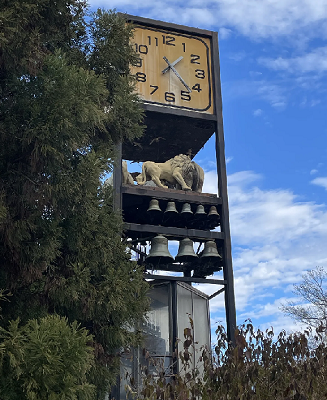
Based on the groaning and clacking of the elevator in which we ascended and descended hundreds of times, I suspect it was original to the 1922 building. The regal staircase leading from the lobby to the second floor was memorable, as was the black and white patterned tile flooring in the public hallways. I remember running down that hall from the apartment to catch up with Poppa. I reached up and took his hand, then shrunk back when the man (not Poppa!) laughed good-naturedly. A gasoline service station was situated behind the complex in an alley, hidden from view. That couldn’t have been good for business. Poppa and Mimi took the younger siblings to the Zoo dozens of times. Joe memorized the names of many of the animals, and could probably still rattle some off. Teresa, Sue, and Cathy remember the chimes of the zoo animal clock, a 38-foot-high ornate carillon just inside the front entrance, audible from Mimi and Poppa’s apartment across the street. The Pelzman Glockenspiel featured four-foot tall mechanical animals circling beneath the clock face every hour with accompanying bells that chimed every 15 minutes. It proved too expensive to maintain and was moved within 10-15 years. Ann later purchased annual zoo parking passes for our families to encourage visits to her and it as our own children came of age.

A Return to the Woodley Lane
“There are places I remember – All my life, though some have changed. Some forever, not for better. Some have gone and some remain.”
John Lennon and Paul McCartney, “In My Life” (1965)
The Connecticut Avenue streetcars stopped running in 1961, making way for buses and – in 1982 – the Metro subway Red Line. Leon’s 1935 boarding house 2811 Connecticut Avenue was razed in 1963. Its attractive three-story connecting neighbor, #2807, still stands. Harry Wardman’s 1918 multi-winged Wardman Park Hotel was torn down in 1978 along with the pool, ice rink, broadcast tower, and lovely lawn area. A not-too unattractive hotel and entry drive were built in its place. St. Thomas school closed in 1986, the hoop-less goals removed and our tennis wall enclosed by the current Montessori school for more classroom space. The snakepit is still there, but a decorative iron fence around the property effectively keeps the snakes out. Oyster was torn down and rebuilt, an apartment house constructed over its athletic field. When Mimi died in 2001, we said goodbye at St. Thomas and sadly emptied her apartment on Connecticut Avenue. When Ann died in 2015 we did the same for our family home on Garfield Street. Having seldom attended St. Thomas since moving away, her funeral Mass and memorial Mass the following year were in a sense goodbyes to more than our mom. The parish thrives, apart from us. The Uptown Theater closed in 2020 and remains vacant. After more than a century the erstwhile Sheraton-Park Hotel closed for good in 2020. All the structures we knew are gone, one notable exception the lovely Wardman Tower.
The meandering Woodley Carriage Lane is also a memory, but one can still follow most of its historic path. From the 1900 block of Columbia Road proceed north onto 19th Street then left onto Belmont Road to the fork at Waterside Drive. Here the Woodley Road descended into the valley, crossing Rock Creek on a wooden bridge beyond what is now the Park Police horse stables. Passing beneath the Taft Bridge proceed up Shoreham Drive and continue uphill on 24th Street. Keeping left alongside the Wardman Tower turn left on Woodley Road past St. Thomas, right on 29th Street, left on Cathedral Avenue past the Swiss Embassy and Maret School, veering right once more to follow Woodley Road past our old paper routes toward the Washington National Cathedral. We played Little League baseball on the grounds of the Cathedral, were members of the Police Boys Club housed at St. Alban’s, and watched the Mall fireworks from its summit a time or two. Our return trip along the former carriage lane to Woodley Park was always downhill.
Many thanks to my siblings for their contributions to this post, and to you for taking the trip with us.
1 Washington Evening Star, July 27, 1874, pg. 2, for example
2 Washington Evening Star, August 7, 1960
3 Wardman’s Washington chronological database, 6/22/1908 https://wardmanswashington.com/database/chronological/ accesses 1/10/2026
4 Washington Sunday Herald and Weekly National Intelligencer, Nov. 28, 1886 – “There will be forty-five villa sites, each with a splendid view… Woodley Park will have no alleys, but each site will have its exclusive roadway. Stables and sheds cannot be erected so as to obstruct the view from other houses, or form unsightly vistas.”


1 Comment
Teresa Gionis
January 15, 2026 at 12:02 pmTearing up. Just wonderful!!